It’s a brewer’s paradise, they said.
When I joined Value Vintage, I was told it was a brewer’s paradise. I saw people posting new brews every day. I saw people who had hundreds of decks brewed… and then there was me: uninspired and devoid of ideas of what to play. Enter me scrolling through decks and seeing UW Spirits, a deck I had experience with in other formats, problem is all the good spirits were over a dollar and Aether Vial, a cornerstone card for decks in Modern and Legacy, was still too expensive
The Fire Nation, though in the game now, is otherwise known as Innistrad Remastered. This set brought down the price of every notable in the spirit and brought the core of THIRTY TWO creatures down to SIX DOLLARS. That’s half a deck’s worth of cards for less than the price of a play booster pack. This wild increase in budget allowed for a strong supporting cast of cards to be played with little issue.
I’m curious! Tell me more
So now that I’ve hopefully got you engaged with my hook, let’s talk about how this deck works. UW Spirits is a tempo deck that aims to win the game by doing the tempo thing, i.e. playing a little guy or two, and attacking them with those creatures while using our interaction to keep our opponent on the back foot. What sets spirits apart from the more delver-esque strategies other formats most commonly see is the fact that our interaction is plastered onto our creatures.
So how do we do that?
Alright time to talk about the cards (I know boo, very boring).
The Haymakers
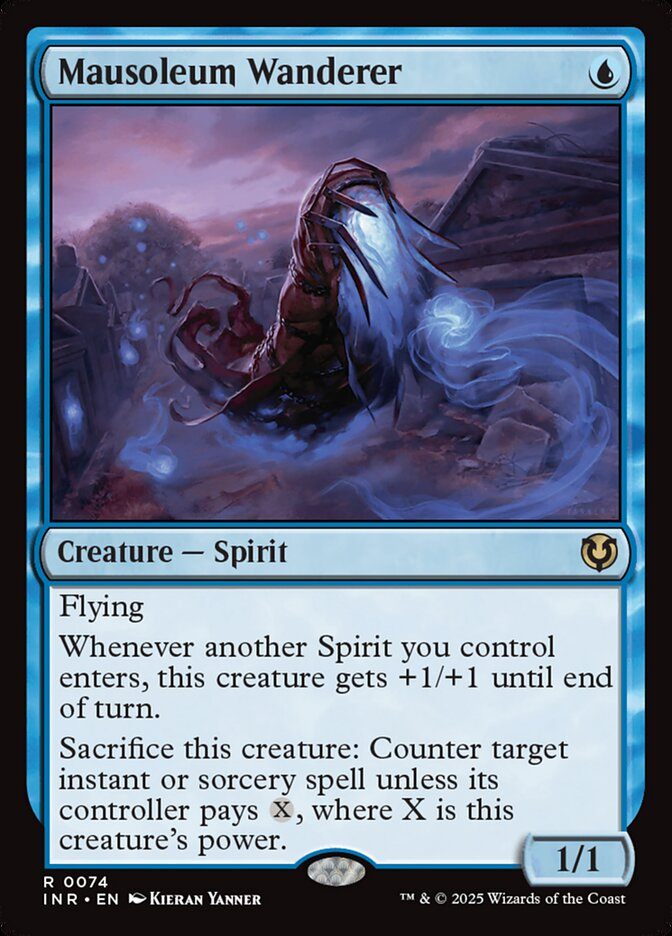
This is the premiere one drop creature in the deck, and for good reason. It’s just so good for its cost. It’s aggro and control all rolled into one. This card can put opponents into a very sticky situation, as it presents a great clock and is often a magnet of removal. I have seen opponents just not play their spells because of the revealed threat of a counterspell and for every turn they delay they take more and more damage.
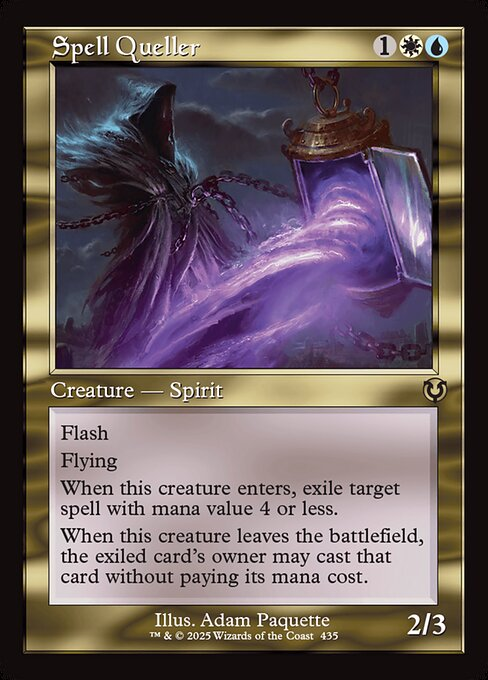
Do you hate it when you want to play a creature but have to hold up countermagic? Enter this guy. Spell Queller is a big reason to be on white, as its ability to counter a spell coupled with it being a 2/3 flyer means that, after you counter their spell, you have a decent creature to bash in with. It’s also good to note that this card has the old templating for these types of effects, meaning that it has a separate leaves trigger that can be triggered before it exiles a spell, leaving the spell permanently in exile. Exiling the spell also gets around “can’t be countered” effects – a rare case, but a relevant one nonetheless.
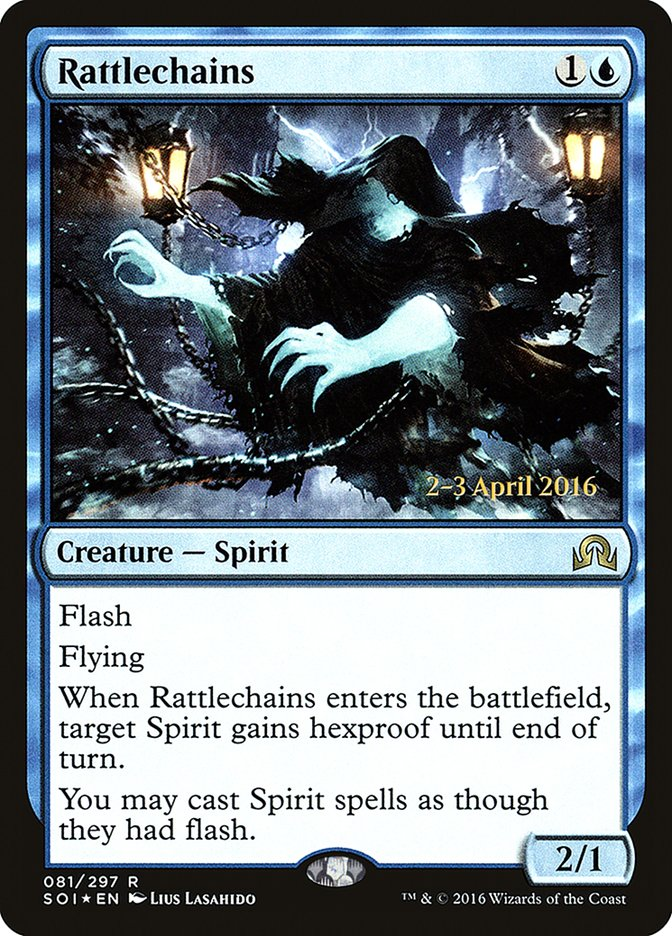
Rattlechains is the biggest unsung hero of the deck, with FOUR lines of text on it that are all relevant. Let’s go through em one by one. Flash and flying are obviously really good, as it can come down after your opponent has expended their resources during their turn, and flying grants evasiveness that is incredibly relevant in a format with both initiative and the monarchy as popular strategies. The ETB is another obviously good ability, often acting as a pseudo-counterspell. But the last line of the card, the one most often treated as flavor text, is the real special sauce: giving cards like Mausoleum Wanderer, Drogskol Captain, and Skyclave Apparition flash can surprise your opponent with damage after they are able to interact, remove their relevant board pieces without closing you off to other interaction options, or grant you additional pieces of face-down permission that can be extra relevant against a spells-based combo opponent. Overall, this is probably one of the best cards in the deck, and people just don’t treat it as such.
The supporting cast
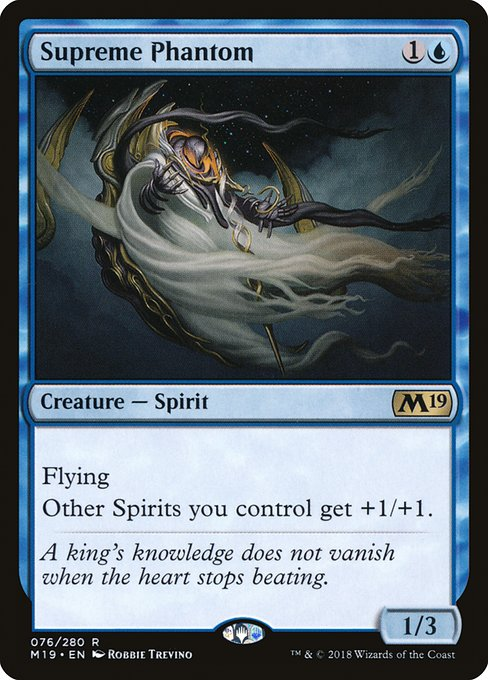
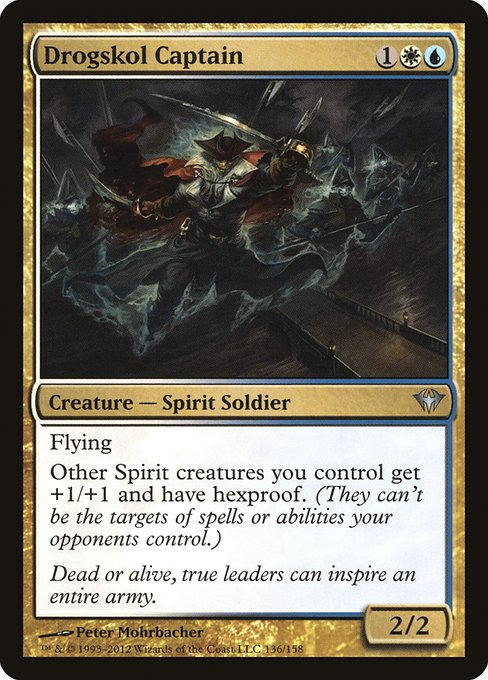
Both these lords are great. Any two mana lord, especially one with flying, can vastly accelerate your closing power, and captain’s hexproof is often game-winning against interaction-heavy decks. Two captains giving each other hexproof is often game over against those decks..
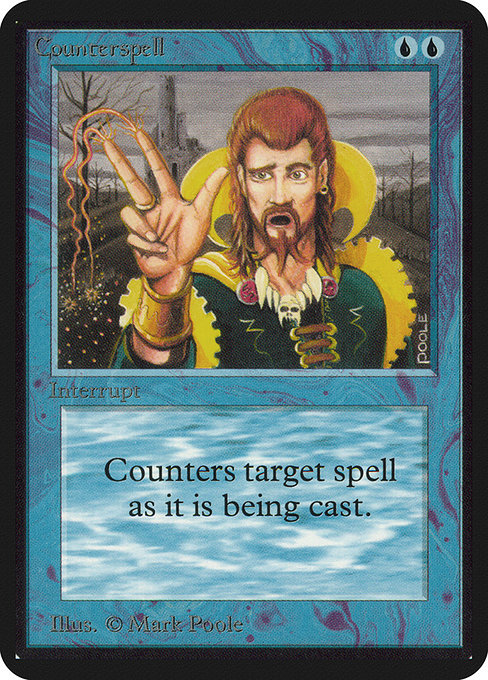
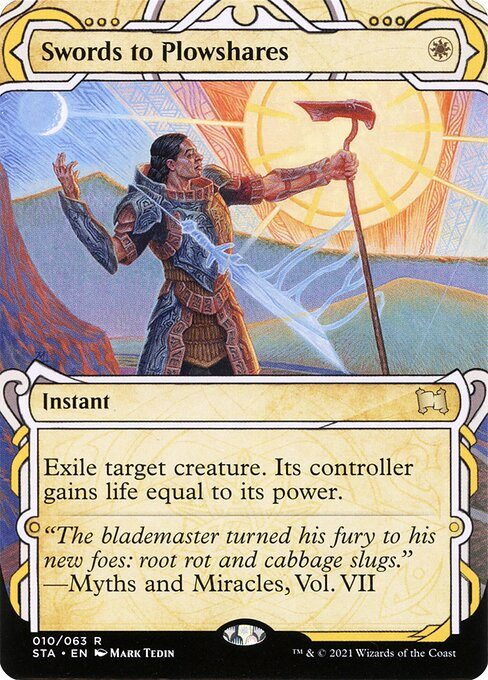
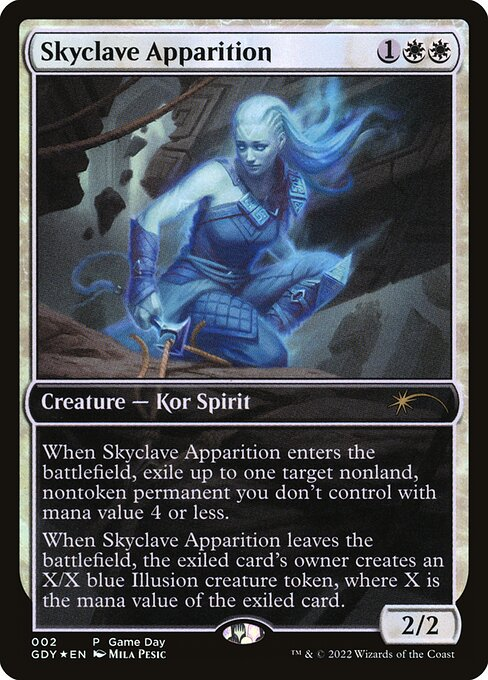
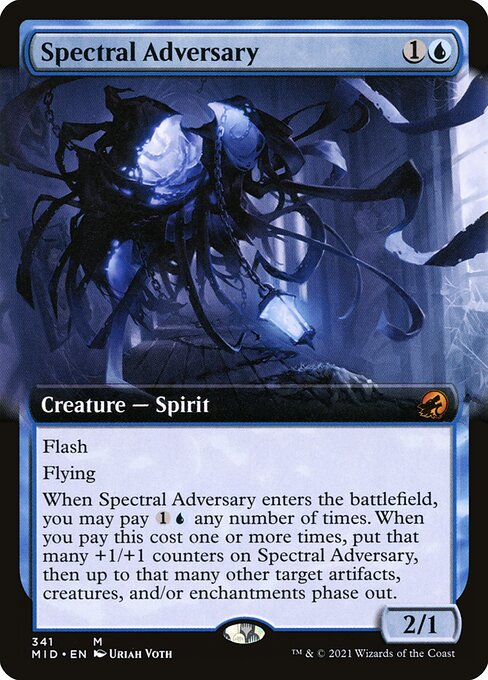
The other interaction. Counterspell (or Lose Focus if you find that counterspell isn’t your taste) and Swords are the premiere countermagic/removal of the format. Skyclave being able to be flashed in, and being able to hit noncreature permanents, gives it incredible flexibility. The most suspect of the bunch is Spectral Adversary; it is often the first to get cut, but it is incredibly flexible regardless: it removes anything, protects your own stuff, and is a large threat that only gets better in the late game.
“A slow version of a basic island”
Aether vial is a very interesting card in spirits. For a cornerstone card for the deck, I only play three copies. Why? It’s not a great draw late game, so having less copies in your deck means that you have less of a chance to draw one later. In my testing, three seems to be the sweet spot, as you have a good chance of having by turn one. We still play it because it feels great in slower matches: being able to cheat on mana, give creatures psuedo-flash, and play multiple creatures early, or play a creature and hold up a counterspell, is a great way to gain tempo. Against control, this lets you put creatures onto the battlefield in a way that can’t be countered, which is really relevant. Often, you want to keep vial at three charge counters, but two can also be a very relevant number.
“A better version of a basic island”
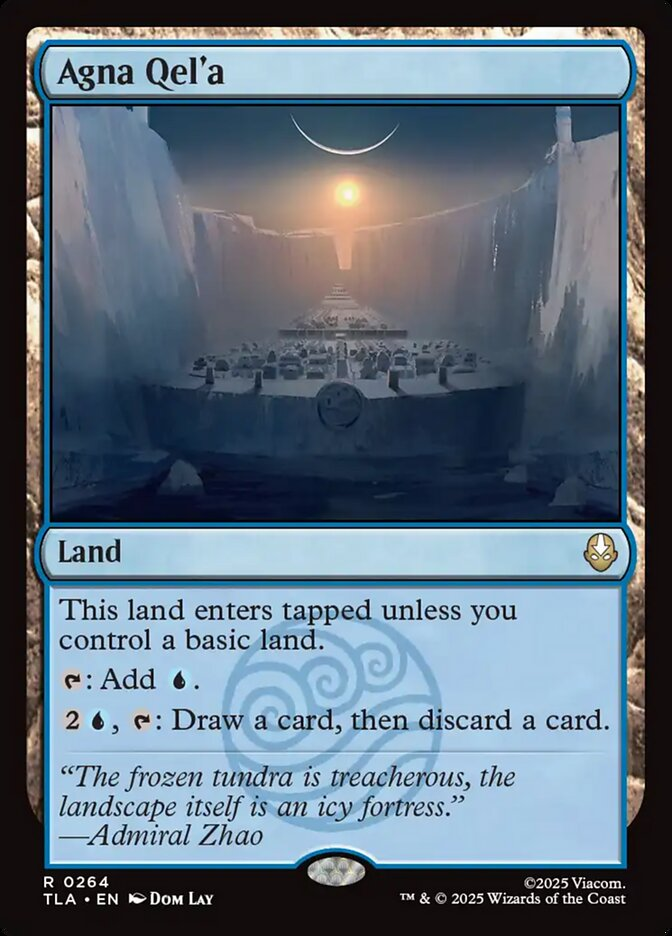
A recent addition to the deck. It’s Desolate Lighthouse all grown up, and that means that when the game goes long you get to dig for more gas. There’s not much to note about this card, but it sure is good.
Get on with it!
Okay Okay. So let’s talk about what you want to be doing during a game.
You know this meme?

Yeah that doesn’t apply to Value Vintage. Cheap decks are not necessarily slow, nor do they always play low-quality cards. We are an incredibly fast format. As such, you need to be doing relevant game actions on turns one two and three. Ideally, our play pattern follows something like this:
- Turn 1
- Get down a one drop flyer (especially Mausoleum Wanderer) and start putting on some pressure. Or, get down an Aether Vial to start setting up for double spells.
- Turn 2
- Either play a Supreme Phantom and put on the beats, or hold up interaction like Counterspell to stop your opponent.
- Turn 3
- From here, the options are more flexible. Skyclave Apparition or another lord can be great, but we also often want to still hold up interaction or play another one drop.
If you made it to turn 3, congratulations! You hopefully have created a stable enough boardstate to be chipping away at your opponent while still interacting. At this point, the fact that all your creatures have flying is very relevant and your opponents will (hopefully) learn this the hard way. 2-4 damage doesn’t seem like a lot, but that number adds up fast when you can’t block any of it.
Important Note
This deck benefits heavily from knowing who the beatdown is. Against a slower deck, you want to be trying to deal as much damage as possible as quickly as possible, while against faster decks, you want to try and slow them down a little.
I know you just talk about every card but lets see the list
With pleasure. Here’s my current one
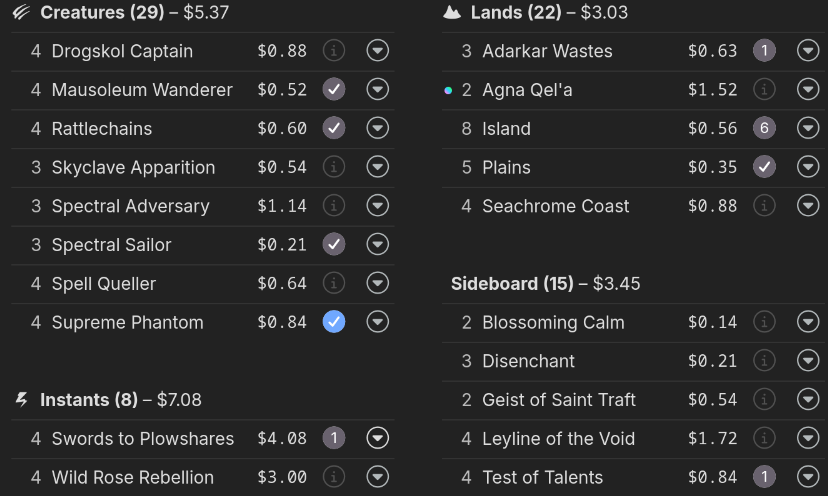
*List as of time of writing this
Some more talking about cards
This is my personal list tuned for the metas I play in and as such means that there are some card choices we need to talk about.
What’s Wild Rose Rebellion
Counterspell. Thanks Universes Beyond for renaming my cards.
The sideboard grave hate
Why Leyline of the void? For me, it was a decent trade off for a card that hits fast graveyard decks (Oops, Dredge), but is also good against value graveyard decks (Hogaak, Roots, ect). You can totally replace it with Ravenous Trap, Rest in Piece, Soul Guide Lantern, Lantern of the Lost, Sanctifier en-Vec, or whatever the heck else tickles your fancy.
Disenchant
Great removal for artifacts/enchantments, Can be replaced with Tempest of Light in more enchantment heavy metas, or Kataki, War’s Wage where artifacts are more prevalent.
What’s that random card that was good in Modern 14 years ago doing here?
At one point, Geist of Saint Traft was good in Modern, but I don’t remember that cause I was four. It was a house for a reason: three mana for six power on two bodies and hexproof is a dizzyingly fast clock, especially against decks slower than you. But if you want to add some more answers to your sideboard feel free to replace it with a Spell Pierce, Stern Scolding, any of the previously mentioned cards or… Meddling Mage?
Wait a minute, what’s a human doing in my spirits deck? They’re not dead yet.
All jokes aside this card can house decks that rely on a specific card to function. As its ability to just shut off a specific card can be backbreaking for some decks. To play this card requires format knowledge but can be very worthwhile against decks that rely on key cards.
One final option is White Plume Adventurer. It won’t be particularly useful against initiative, as we already dominate that matchup, but the card’s raw power level cannot be denied, especially against slower control decks where the initiative has time to take over.
Which cards do I want to see at the start of the game?
Ah, mulligans: a skill that I’m notoriously bad at due to my laziness. Let’s talk about some hands that you do and don’t want to see.
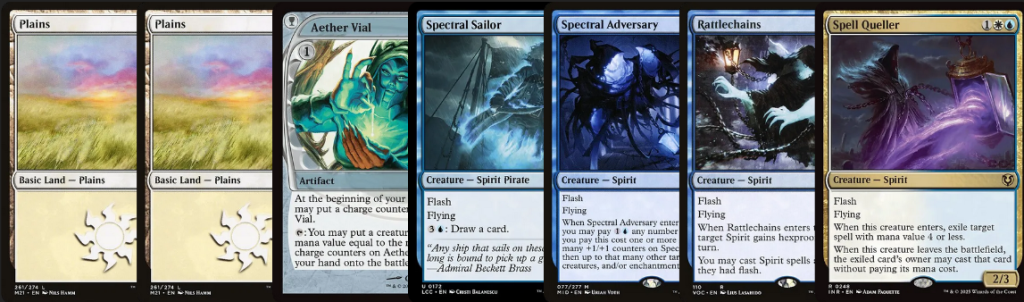
This hand looks great, until you realize that you can’t actually do anything relevant until at least turn three. Two plains is not great with a handful of blue cards and after turn 1 vial you can’t cast any of your spells. This hand is bad because you can do anything early and there’s little interaction to deal with whatever your opponents are doing. Mulligan this.
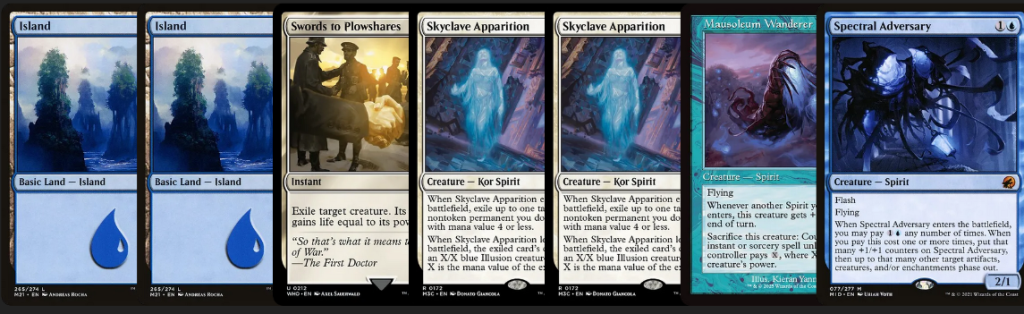
This is another bad hand. Two islands means you only get access to two cards in your hand and you now have to draw into two more white sources to play the other half of your hand. Easy mulligan.
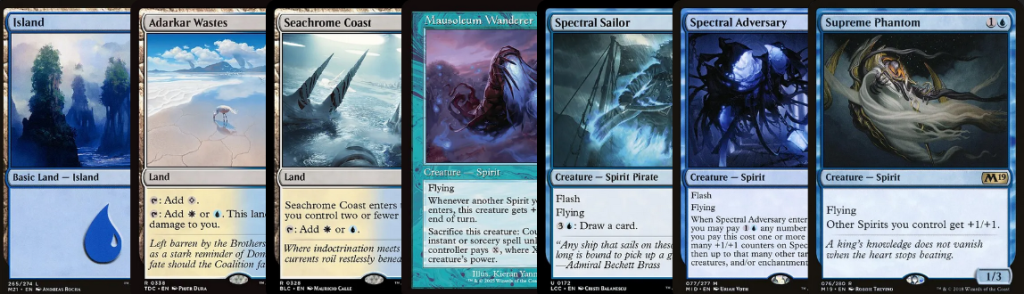
This is a fine hand especially on a mulligan to six or lower. You can get early pressure out with a Mausoleum Wanderer and Supreme Phantom, or if you can see that your opponent is on a fast combo deck, holding up Spectral Sailor/Adversary can mean surprising your opponents with having to pay more for their spells than they thought. If on a mulligan, I’d probably put back Spectral Adversary and then either Island or Spectral Sailor depending on what I’m up against.
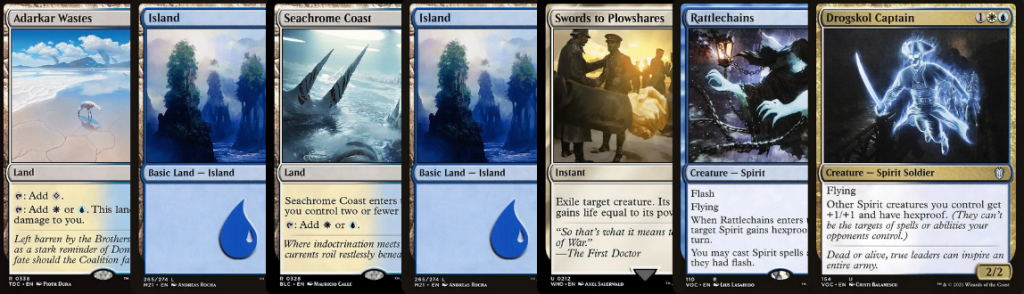
Another hand to be sent back. Swords to Plowshares on turn 1 is often not relevant and playing Rattlechains on turn two is not what you want to be doing with no other creatures on the board. This hand just has too many lands and not enough relevant actions against our opponents. Send it back for another hand.
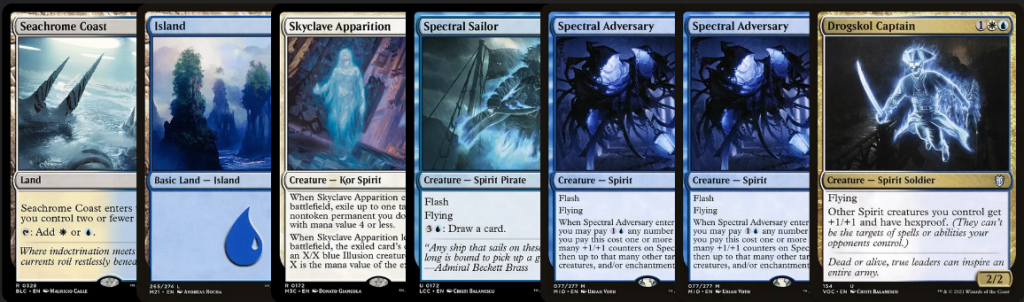
This is an interesting hand because this is a mulligan at a seven or six but keep at a five. It’s an okay aggressive hand that plays mostly at flash speed, but represents no real way of interacting with our opponents. I’d for sure put back a Spectral Adversary and then either Skyclave Apparition or Drogskol Captain, depending on if I want to bank on drawing a white source for that interaction or banking on another land to keep the pressure coming.
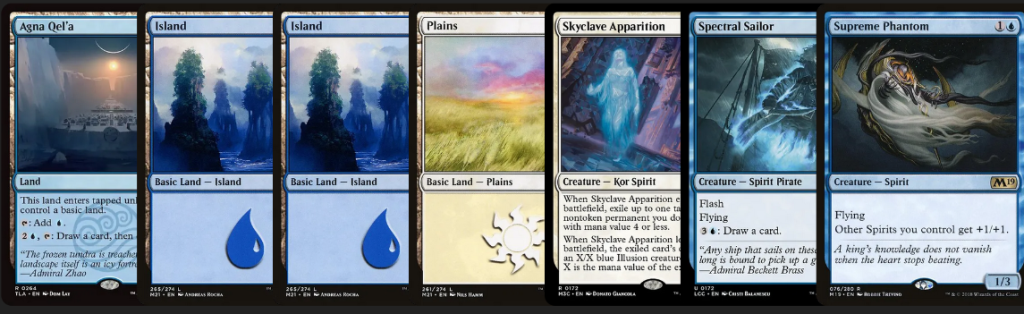
Another hand that I’d keep at a five or four, but ship anytime before. Island, Skyclave, and Agna Qel’a are coming out in that order and I’m hoping in the heart of the cards to draw something good.
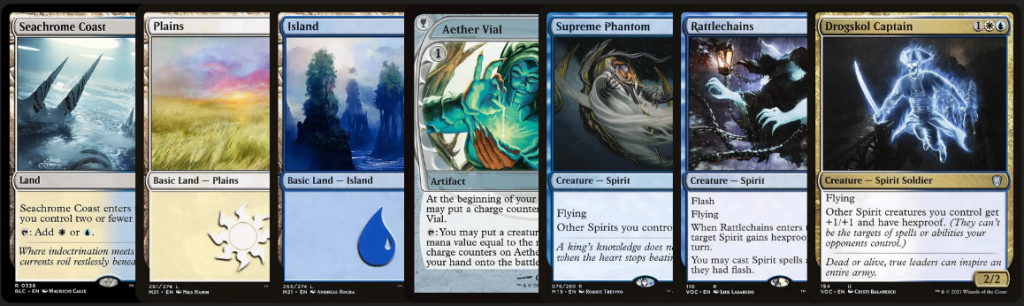
This is a hand that looks good, but in reality is so slow it’s only worth it against a known control deck. Turn 1 vial is great, but then you’re forced to probably flash in Rattlechains on your opponents end step and hope that the one or two lords you can play after that can give you the clock to end the game, and knowing my luck, I’ll probably just flood out in the meantime. This hand is only really good against something like control and you are going to pretend to have the interaction that we both know you don’t got.
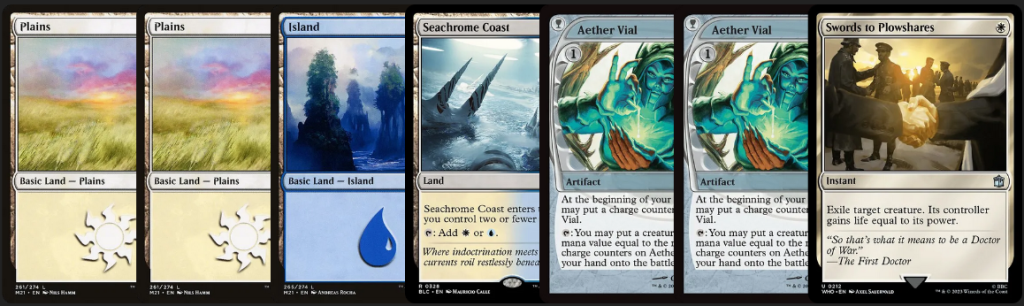
This is another bad hand if only for the fact that you don’t do anything with it. You don’t get turn 1 Mausoleum Wanderer, you don’t get great interaction and you can’t cast your spell on curve when you want them. Please mulligan this.
If you keep this hand please consider seeing a mental health professional.
This hand whispers to you sweet nothings about how great it is and then underperforms like hell when you actually try and play it. Great against slow decks loses you the game against anything faster. Just put it back.
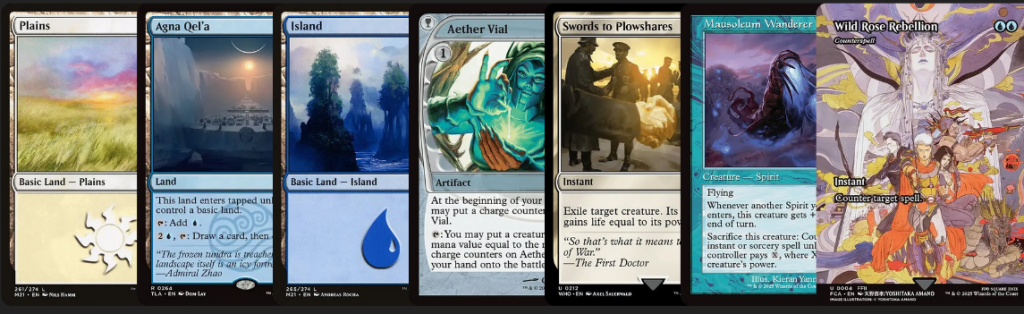
This hand is the tempo hand of all time. Turn 1 little guy into turn 2 interaction and pray. Vial is actually a trap here because you can’t actually play anything with it. I’d probably put it back but if you’re on the play against some turbo combo nonsense you might want to keep.
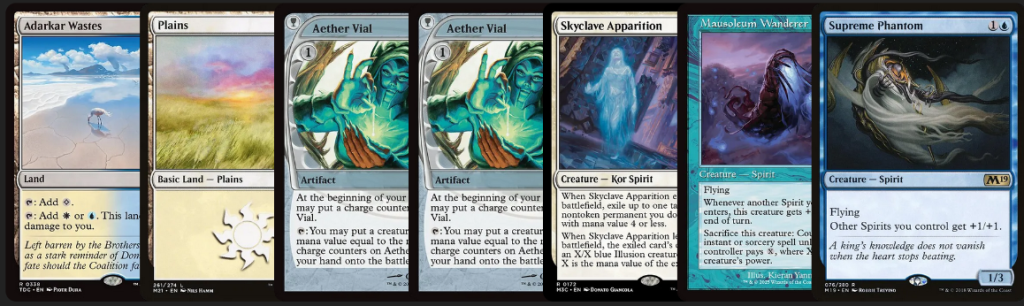
Here’s a hand that as a blind seven is interestingly playable. Turn 1 and 2 we’re playing Aether Vials because against slower decks nothing is better than being able to hold up free uncounterable interaction and against something a little faster this represents a way for us to cast our good creatures while holding up mana for interaction or Spectral Sailor activations. This hand is fine as a seven all the way down to a five.
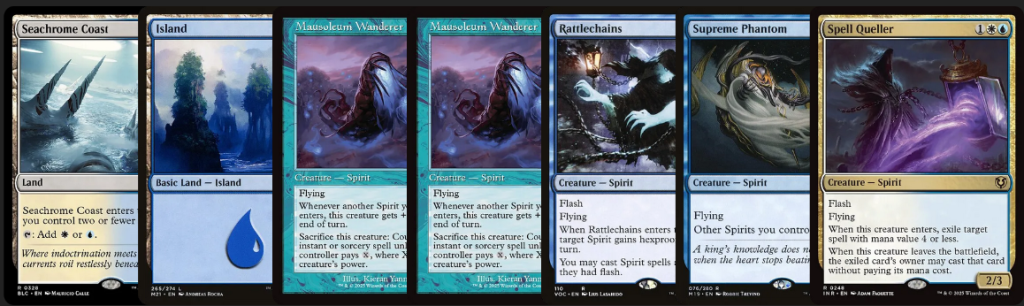
Congratulations, you have just won the lottery. This is a nearly ideal hand. Mausoleum Wanders provide fast pressure and you can either speed up the clock with Supreme Phantom or hit them where it hurts with Spell Queller. Hands like this have won me games fast and have been able to keep me there in the long run.
What do I do after game 1?
Combo
In general, spirits has a good matchup due to our plentiful interaction and ability to keep up a clock for the game.
In:
+ 4 Test of Talents
+ 2 Blossoming Clam (if your opponent’s wincon targets you)
+ 4 Leyline of the Void (if your opponent’s wincon involves the graveyard)
Out:
– 1-3 Skyclave Apparition
– 1-3 Spectral Adversary
– 2-4 Droskol Captain
Against any sort of cascade or spellslinger combo, we’re bringing in Test of Talents. This puts us at 16 counterspells in deck which is enough to almost always have one by turn 2. Blossoming Calm also comes in if your opponent’s wincon targets you in any way. Lastly, if you’re up against any sort of graveyard combo list just bring in your grave hate. That’s the easiest way to win.
Coming out is Skyclave Apparition: either your opponent is trying to beat you with instant and sorceries, or their creatures can’t be hit by Skyclave’s ability (i.e. Footfalls or Hypergenesis decks). Spectral Adversary comes out for about the same reason. Drogskol Captain is a good candidate to come out as well if you’re trying to keep as much interaction as possible, for the same reason Aether Vials can come out as well.
Against combo, our goal is to land an early guy, hold up interaction, and chip away at your opponent’s life total.
Unfortunately Modern Horizons 3 Brought us Nadu, Winged Wisdom, an absolutely heinous card that enables a fast combo that has staying power the whole game. Your best course of action against Nadu strategies is to try and counter their key spells; once the bird hits the battlefield, it can often be too late.
Control
Luckily for you, control is a very winnable matchup.
In:
+ 2 Geist of Saint Traft
+ 2-4 Test of Talents
Out:
– 1-3 Skyclave Apparition
– 1-3 Spectral Adversary
– 1-2 Drogkol Captain (keep these if your opponent targets your creatures)
– 1-4 Supreme Phantom
Coming in is often Geist Of Saint Traft and Test of Talents. The former because if it sticks it almost certainly wins you the game with its large damage and hexproof. And the latter because what’s better than countering their counterspell, countering it and also exiling every other copy of it from their deck. While what’s getting cut is often Spectral Adversary, Skyclave Apparition, and maybe a few copies of Drogskol Captain or Supreme Phantom Depending on if they are playing targeted removal or not.
Your gameplan is to land a vial and then go to town. You are the beatdown in this matchup and should play it as such. Agna Qel’a and Rattlechains are your best friends here, either allowing you to dig for more gas, or letting you play your cards on their turn and overwhelm them to hopefully land a threat.
If your opponent is on either a Wilderness Reclamation, Rest in Piece + Energy Field, or Thopter Foundry + Sword of the Meek deck, this is where the Disenchants, Skyclave Apparition, and Spectral Adversary effects become great, as they allow you to either just remove their lock piece, or do that plus advance your board state. This is the time to be cutting Supreme Phantoms and Drogskol Captain as the added interaction is worth the loss in damage.
Midrange
Outside of combo, this is probably the most common deck you will face. The good thing is that our game plan doesn’t really change against these decks.
In:
+ 0-2 Geist of Saint Traft
+ 2-4 Leyline of the Void (if your opponent’s deck heavily utilizes the graveyard)
Out:
– 1-3 Skyclave Apparition
– 1-3 Spectral Adversary
– 1-2 Drogkol Captain (keep these if your opponent targets your creatures)
What comes in is really matchup dependent, but a lot of the time I’ll find myself bringing in Geist of Saint Traft if I want early pressure and Leyline of the Void if they use their graveyard.
What comes out is usually matchup dependent, but some amount of Spectral Adversary, Skyclave Apparition, and maybe a few copies of Drogskol Captain are the usual suspects. These cards are really powerful but are often the cards I feel can be the weakest link post-board.
Your gameplan is simple: stick guys for pressure and try and disrupt your opponents key cards. Be it Pyre of Heroes, Minsc and Boo, or Lurrus, stopping these cards from hitting the battlefield while pressuring your opponents’ life total is oftentimes enough to win games.
Initiative is often creature-based midrange decks’ biggest adversaries, but for spirits, it’s an incredibly favorable matchup. Often, you want to focus on removing their initiative creatures after they land, rather than addressing them on the stack, because your beaters fight so well for the initiative. Don’t let them slip an initiative threat out on an empty board and you should be alright.
Aggro
How should I put this? This macroarchetype is not a great matchup for us, but fortunately, not many people play it, because burn can only be so engaging after your tenth match.
In:
+ 2 Blossoming Calm
+ 0-4 Test of Talents (if your opponent’s deck is very spell focused)
Out:
– 1-3 Skyclave Apparition
– 2-4 Drogskol Captain
What comes in. Against Burn you’re gonna want your blossoming calms as they just say no to burn spells for two turns and gain you 4 life apiece. Additionally you might want some copies of Test of Talents as it’s the only counterspell we have that can also hit extra burn spells.
What comes out. Whatever feels like it’s the slowest card that you wouldn’t want to draw, which is often Drogskol Captain or Skyclave Apparition .
Your gameplan is to play the control deck and try to pressure using your little guys. If they’re not on Burn, the matchup is slightly more winnable, as we play enough removal that you can often keep them off-kilter long enough to stabilize. Spectral Adversary shines in this matchup as it can often swing you from being in a losing boardstate to being able to push in enough damage to win the game.
Thanks for your time
Well, that’s about it! This deck is a blast to play and always feels like it has game against other decks. If you’re new to the deck, I hope this helps and convinces you to play it, and if you’re just reading this because you want to know how to gameplan around Spirits, I hope you realize how fruitless it is to play against it. As always, this is not the definitive best list, just my list that has had success. Keep brewing, innovating, and trying new things. Also, feel free to also hit me up about spirits – I love to talk about it!
Thanks for taking the time to read this
-Mori